


Summary:
Most apparel factories expect a deposit of 30-50% to book your production slot, with the balance due against evidence the order is complete, not before it ships. Paying 100% up front removes your only leverage if quality slips; paying nothing leaves the factory with no reason to prioritize your run. The safest structure for a first order ties payment to three gates: deposit to start, approval of a pre-production (PP) sample before bulk cutting, and balance against shipping documents or video evidence, not a promise. Marketplace escrow like Alibaba Trade Assurance protects the deposit stage well but does little once goods ship under your own terms.
Why Two Opposite Payment Mistakes End the Same Way
Search “clothing manufacturer scam” and you’ll find the same story repeated with different brand names: a founder wired the full invoice, the factory stopped responding, and the money never came back. Search the opposite story, a brand that paid in full, received the goods, and still lost, and you’ll find the same ending with a different villain. The shirts arrived with crooked seams and mismatched shade, and because the balance was already paid, the factory had zero incentive to fix anything.
Neither story is really about fraud or bad manufacturing. Both are about payment structure. The buyer in each case paid away their leverage before the work that mattered was actually done.
This guide covers exactly how payment should be staged on a clothing order. Specifically for the size of the order most new brands are actually placing, somewhere between $3,000 and $8,000, not the $50,000 container loads most trade-finance content is written for. It also states, plainly, what Affix’s own terms are. On a topic where trust is the entire sale, that transparency matters more than a sales pitch.
Why Payment Structure Matters More Than Price

A quote that looks 10% cheaper than a competitor’s means nothing if the payment terms attached to it leave you with no recourse when something goes wrong. Price is the number everyone negotiates. Payment structure is the term almost nobody asks about, and it’s the one that actually determines what happens if your order goes sideways.
Here’s the asymmetry that makes this matter: once a factory has 100% of your money, your only tools for fixing a problem are asking nicely and leaving a bad review. Once you’ve paid nothing, the factory has no capital at risk and little reason to prioritize your slot over a bigger client’s. The right structure keeps both sides exposed to something, which is exactly what keeps both sides motivated to get it right.
What a Normal Deposit Looks Like
A deposit is the portion paid before production starts, and it exists for a reason that has nothing to do with distrust: it buys materials and books a slot on the production line. Factories operate on thin working capital. They are not going to purchase fabric, trims, and thread for your specific order on the hope that you’ll pay once it’s finished.
Across small-to-mid-run apparel manufacturing, a deposit of 30-50% of the total invoice is the conventional range. On a $5,000 order, that’s 1,500-2,500 to begin. Anything meaningfully outside that range deserves a direct question before you send a cent.
- Below 20-30%: Not necessarily wrong, but ask why. Some factories offer lower deposits to win new clients, which is fine, but confirm the balance terms are still tied to completion, not shipment, before assuming it’s a good deal.
- Above 60%, or 100% up front: This is the structure behind nearly every “I paid and got nothing” story. There is rarely a legitimate production reason a factory needs more than half your money before cutting a single piece of fabric.
50/50 vs. 30/70: The Two Structures You’ll Actually See
Two splits dominate small-order apparel manufacturing, and they shift risk differently.
50/50 split. Half the invoice up front, half due before or at shipping. This is the most common structure for first-time orders in the $3,000-8,000 range, and it’s the one Affix uses by default. It’s simple and easy for both sides to track against a single proforma invoice and keeps the factory’s capital exposure and your leverage roughly balanced throughout the run.
30/70 split. A smaller deposit, sometimes as low as 30%, with a larger balance due later, occasionally broken into stages. This can favor the buyer on cash flow, but it shifts more risk onto the factory, which means it’s typically offered only to brands with an established order history, not a first-time buyer with no track record. If a new factory offers you 30/70 on your very first order with no history between you, that’s worth a second look rather than a quick yes. It’s an unusual enough concession that it’s worth confirming nothing else about the terms has changed to offset it.
Neither split is inherently “better.” The split matters less than what’s tied to each payment, which is the part most guides skip entirely.
The Part That Actually Protects You: Tying Payment to Gates

A percentage split alone doesn’t protect you. What protects you is refusing to release each payment until a specific, verifiable milestone is met. This is milestone payment structuring, and it’s the single highest-leverage thing a first-time buyer can set up before placing an order.
For a standard apparel order, three gates matter:
Gate 1 — Deposit to start. Paid against a signed proforma invoice that specifies style, quantity, price, fabric, and delivery date in writing. This is the document that defines what you’re actually paying for; never wire a deposit against a verbal quote or a chat message alone.
Gate 2 — PP sample approval. The pre-production (PP) sample is built from your confirmed fabric and trims, exactly as bulk production will run it, the last checkpoint before the factory cuts yardage for your full order. This is the single highest-leverage moment in the entire process: once bulk cutting starts, changing course costs real money for both sides. No mid-size payment should release until you’ve approved this sample. If a factory pushes to skip PP approval and move straight to bulk, that pressure is itself a signal worth pausing on.
Gate 3 — Balance before shipping. The remaining balance is conventionally due against evidence the order is complete, a final inspection report, time-stamped photos or video of packed cartons, or a quality-control sign-off, not against a promise that goods “will ship once payment clears.” Paying the balance before you have any evidence of what you’re actually getting hands back is every bit of leverage the deposit structure was designed to protect.
Cash-Out-by-Week: What This Looks Like on a Real Order
Here’s how the gates map onto an actual timeline, using a 150-unit order at roughly $34/unit, a realistic first run for a brand placing a $5,100 order.
| Week | Stage | Amount Due | What Unlocks It |
| Week 1 | Deposit (50%) | $2,550 | Signed proforma invoice confirming style, fabric, quantity, price, and dates |
| Weeks 2-3 | PP sample review | $0 | No payment; this is an approval checkpoint, not a payment checkpoint |
| Weeks 4-5 | Bulk cutting begins. | $0 | Triggered by your written PP sample approval, not a new payment |
| Weeks 6-7 | Production complete | $0 | The factory requests a final inspection. |
| Week 7 | Balance (50%) | $2,550 | The final inspection report or packed-carton video confirms the order matches the spec. |
| Weeks 7-8 | Shipment released | — | Released only after balance clears |
Notice what’s missing: a payment tied to “production has started” or “halfway through the run.” Those checkpoints are useful for your own planning, but they shouldn’t trigger a wire transfer. The only two moments that should move money are the start (deposit against a signed proforma) and verified completion (balance against inspection evidence). Everything in between is approval, not payment.
T/T, Escrow, and What Marketplace Protection Actually Covers
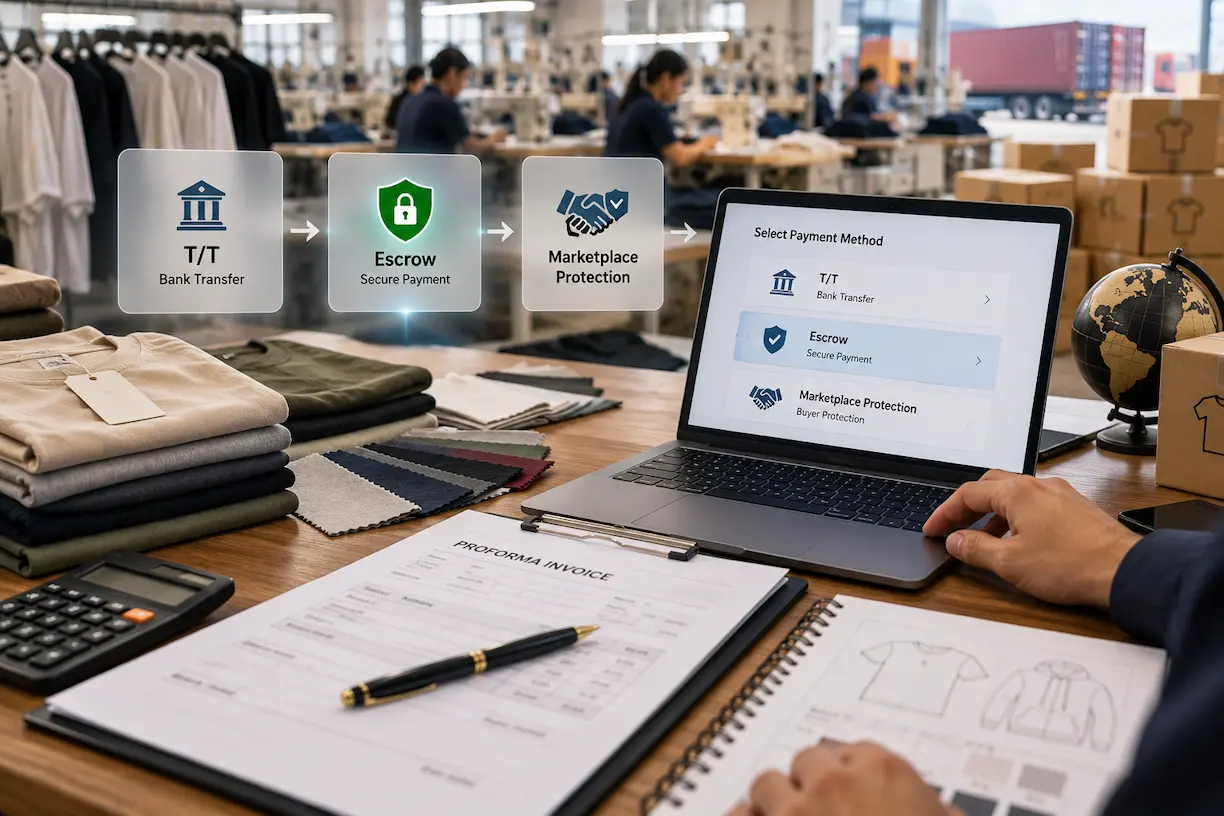
T/T (telegraphic transfer) is simply a bank wire, the standard method for paying a factory directly, used for both the deposit and balance stages. It’s fast and nearly universal, but a T/T sent directly to a factory’s bank account carries no built-in recovery mechanism if something goes wrong. That’s the gap escrow and marketplace protection exist to close, partially.
Escrow, in sourcing, means a third party holds funds and releases them only once agreed conditions are met, rather than funds going straight from buyer to factory. Alibaba Trade Assurance is the most common version a small brand will encounter: it holds your payment and is designed to release it based on agreed terms, with a dispute process if the order doesn’t match what was agreed.
Here’s the part worth understanding clearly before you rely on it: Trade Assurance protects the transaction as structured on the platform; it’s strongest for verifying that goods match the agreed specification and timeline for an order paid and tracked through Alibaba itself. It does not retroactively cover money sent by direct T/T outside the platform; it does not extend once you’re dealing with a factory on repeat orders handled outside the marketplace relationship, and dispute resolution still requires you to document discrepancies properly, photos, inspection reports, and the original proforma invoice rather than assuming the platform will take your word over the factory’s. Treat it as one more layer in a staged-payment structure, not a replacement for one.
What a Chargeback Can and Can’t Undo
A chargeback, disputing a card payment through your bank or card network, is sometimes treated as a safety net of last resort. It’s worth understanding its real limits before you count on it. Chargebacks exist for consumer card transactions, and many factories won’t accept card payment at all for exactly this reason, or will only accept it for a sample invoice, not a full production run. Even where a chargeback is technically available, it’s a slow, evidence-heavy process, and a factory that’s already been paid in full has little reason to cooperate with your bank’s investigation. A chargeback is a possible recovery path after something has already gone wrong. It is not a substitute for structuring payment correctly before anything goes wrong.
What to Accept and What to Refuse

Accept:
- A 30-50% deposit tied to a written proforma invoice
- A balance due against inspection evidence or shipping documents, not a promise
- A PP sample approval gate before bulk cutting begins
- Payment through Trade Assurance or a comparable escrow option, where available
Refuse or question hard before agreeing:
- 100% payment up front, regardless of the discount offered for it
- A balance due “once goods are ready to ship” with no inspection evidence attached
- Pressure to skip the PP sample stage to “save time”
- A request to move an established escrow-platform relationship to direct bank transfer for no stated reason
What Happens If the Sample Fails
This is the scenario that worries first-time buyers most, and it’s also the clearest argument for gated payment. If a PP sample comes back with real problems, wrong measurements, incorrect fabric weight, or visible construction flaws, your deposit has already been paid for sampling and setup work the factory genuinely performed. That’s expected; it’s not lost to fraud. What matters is what happens next: a factory operating in good faith will revise and resubmit the sample before asking for anything further, because the remaining balance is only released once that sample is approved and the order ships complete. This is precisely why the balance should never be released early; it’s the only remaining incentive for the factory to get the revision right.
Affix’s Own Payment Terms
On a topic this trust-sensitive, the most useful thing we can do is state our own terms rather than ask you to take a generic guide on faith. Affix Apparel runs a standard 50/50 split: 50% deposit against a signed proforma invoice to begin production, and the remaining 50% is due after PP sample approval and before final shipment, confirmed against inspection documentation. We don’t request full payment up front, and we don’t release a shipment against an unpaid balance. If you want to see this in writing before you commit to an order, our secure payment process and terms are outlined on our FAQs page, and our team is glad to walk through the specifics for your order size before you send a deposit. Reach out to us through contact us with any questions.
Frequently Asked Questions
How much deposit is normal for clothing manufacturing?
30-50% of the total invoice is standard for a first order in the $3,000-8,000 range, due against a signed proforma invoice. Above 60%, or a request for full payment up front, falls outside normal practice and is worth questioning directly.
Should I pay a clothing factory in full up front?
No. Paying 100% before production removes your only leverage if the PP sample fails or finished goods don’t match spec. A staged structure, deposit to start, and balance against completion evidence protect both sides without requiring either party to work on blind trust.
What does 50/50 payment mean?
It means 50% of the total order value is paid as a deposit to begin production, and the remaining 50% is paid once the order is complete, typically confirmed by an inspection report or shipping documentation rather than released on a promised ship date.
Is Alibaba Trade Assurance real protection?
It’s real, but partial. It protects transactions paid and tracked through the platform against orders that don’t match agreed specifications or timelines, with a documented dispute process. It doesn’t cover direct bank transfers made outside the platform, and it works best when you keep your documentation, proforma invoice, sample approval, and inspection evidence organized throughout.
What happens to my deposit if the sample fails?
A failed PP sample on a legitimate order typically means revision and resubmission, not lost funds; the deposit covers the sampling and setup work already performed. The balance stays unreleased until a revised sample is approved and the completed order is verified, which is exactly the leverage a staged payment structure is designed to preserve.


