

Summary
Clothing production lead time starts at payment clearance and final artwork approval, not the day you first reach out, a distinction responsible for more missed launch dates than any actual production delay. Decorated blanks (screen printing, embroidery, and sublimation) typically take about two weeks; cut and sew runs three to six weeks depending on complexity. Shipping is separate from both. This guide shows exactly how to work backward from a real in-hand date to the order-by date that actually protects it.
The Clock You Think Is Running Isn’t
Here’s the single most common way a launch date gets missed, and it has nothing to do with a factory falling behind: a buyer reaches out on March 1st, gets a “3–6 weeks” turnaround estimate, and mentally starts counting from March 1st. The order doesn’t actually get placed, payment cleared, or artwork approved, until March 12th, after a few rounds of back-and-forth on pricing and design details that felt quick in the moment but quietly ate nearly two weeks. Now the buyer is expecting delivery around mid-April, and the factory is correctly counting from March 12th, landing closer to late April or early May.
Nobody lied. Nobody missed a deadline they committed to. The buyer was simply counting from the wrong day, and this single misunderstanding is responsible for more “why is my order late?” conversations than actual production delays. It’s also almost entirely avoidable with one piece of information: the exact day the clock starts and a calendar that works backward from there instead of forward from a guess. This guide is that calendar.
What Actually Starts the Clock
Clothing production lead time doesn’t start when you first make contact, when you get a quote, or even when you place an order. It starts at the production start trigger, the point where every required input has actually been received and confirmed. For most orders, that means two specific things have both happened:
Payment clearance. Production doesn’t begin on an invoice sent; it begins once payment has actually cleared, which can itself take a few business days depending on the payment method. A wire transfer initiated on a Friday may not clear until the following Tuesday or Wednesday.
Final artwork or spec approval. If your order involves a print, embroidery design, or a full tech pack for cut and sew, the clock doesn’t start until you’ve signed off on the final version, not a first draft, not a “looks good, just fix the color” round that still needs another look.
The practical rule: your turnaround estimate applies from the later of these two events, not from your first conversation. If payment clears on Monday but artwork approval doesn’t happen until Thursday, your clock starts Thursday.
Turnaround by Order Type: Three Real Calendars
Different order types carry genuinely different timelines, and conflating them is the second most common planning error after the payment-date confusion above.
Decorated Blanks: Screen Printing, Embroidery, Sublimation
Typical turnaround: approximately two weeks from production start.
This is the fastest path because the garment itself already exists; you’re decorating an existing blank, not building a garment from raw fabric. The stages:
| Stage | Owner | What Pauses the Clock |
| Payment clearance | You | Payment method processing time |
| Final artwork approval | You | Revision rounds you haven’t signed off on |
| Blank garment sourcing | Factory | Rare, but possible on unusual colors/sizes |
| Print/embroidery/sublimation production | Factory | — |
| Quality check | Factory | — |
| Packing | Factory | — |
Because decoration is applied to a stock item, this is the shortest realistic timeline for a custom order, which is exactly why it’s the right call for a tight-deadline event and why screen printing is worth considering specifically when your in-hands date is close and cut and sew simply isn’t feasible.
Cut and Sew: Standard Fabric
Typical turnaround: three to six weeks from production start.
Here, the garment is actually being constructed, cut, sewn, and finished, which introduces more stages and more approval gates:
| Stage | Owner | What Pauses the Clock |
| Payment clearance | You | Payment method processing time |
| Tech pack finalization | You (with factory input) | Incomplete specs requiring clarification |
| Sample production | Factory | — |
| Sample approval | You | Slow feedback turnaround |
| Bulk cutting and sewing | Factory | — |
| Quality inspection | Factory | — |
| Packing | Factory | — |
The sampling window and its approval gate are the biggest variables in this timeline. A buyer who reviews and approves a sample within 24–48 hours keeps the schedule intact; a buyer who takes a week to respond adds that same week directly onto the back end of the delivery date, with nothing the factory can do to recover it.
This is the realistic range for most cut-and-sew clothing orders, and it’s meaningfully longer than decorated blanks for a structural reason, not a slower factory, more stages, or more approval points. For more places, the calendar depends on your response time as much as production capacity.
Cut and Sew With Custom Fabric
Typical turnaround: toward the longer end of the three-to-six-week range, or beyond, depending on the fabric.
This is the calendar most buyers underestimate, because it adds a dependency that doesn’t exist with stock fabric: sourcing or dyeing the fabric itself before cutting can even begin. If your fabric requires a custom dye lot, that’s an additional production step with its own lead time layered before the garment-construction stages above even start. Budget extra time here specifically, and confirm fabric lead time as a separate line item from garment production time; don’t assume it’s already baked into the standard cut-and-sew estimate.
Transit Time Is Never Included in a Production Quote

This is worth its own section because it’s one of the most consistently forgotten pieces of the calendar. “Three to six weeks” is a production estimate. It does not include shipping.
Domestic ground shipping can add several days; expedited shipping cuts that down at a real cost premium; international shipping adds considerably more time and introduces customs clearance as an additional variable outside anyone’s direct control. Your in-hands date, the date you actually need product in hand, has to account for production time plus transit time as two separate additions, never as one blended estimate.
The math that actually protects a launch: In-Hands Date = Order-By Date + Production Time + Transit Time + Buffer.
Buffer: The Line Item Most Buyers Skip Entirely
Speaking of buffer, build one in, always, and build a bigger one for anything time-sensitive.
For a standard reorder with flexibility on the exact delivery day, a modest buffer of a few days covers minor, normal variability.
For an event or a hard launch date, the buffer needs to be substantially larger, commonly recommended at one to two full weeks beyond the calculated production-plus-transit estimate. Event and seasonal buyers get hit hardest by tight timelines, specifically because an event date doesn’t move if a shipment runs a few days late, the way a soft e-commerce restock date can quietly slip without anyone really noticing.
Peak season congestion compounds this further. Late summer through the holiday season, when back-to-school, corporate holiday gifting, and holiday retail orders all compete for the same production capacity, routinely pushes standard turnaround estimates longer, purely due to capacity booking pressure across the industry, not a slowdown at any single factory. If your in-hands date falls in this window, add a buffer specifically for that congestion on top of your normal buffer, and book your production slot earlier than you would in a quieter month.
Rush Fees: What They Actually Buy You
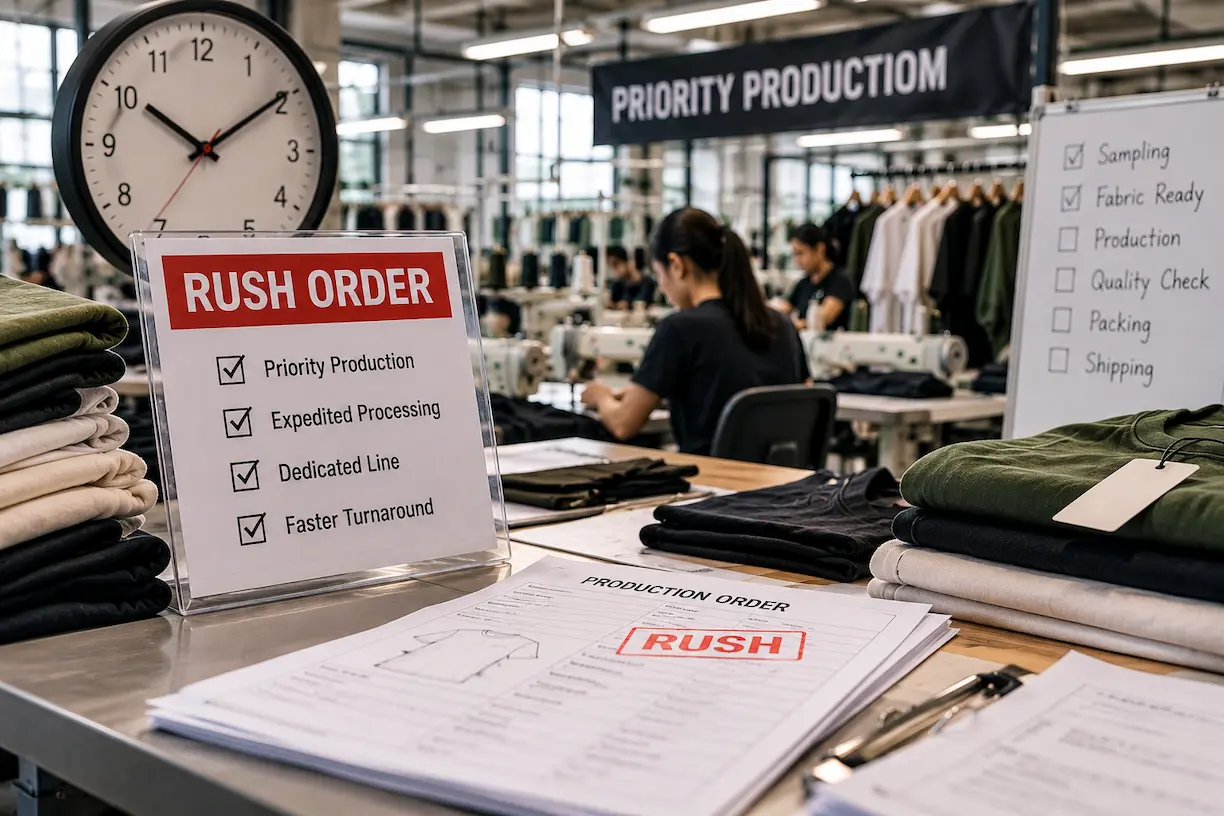
If your timeline is genuinely tight and the buffer isn’t realistic, a rush fee can compress standard turnaround, but it’s worth understanding what it actually purchases: production priority, not a suspension of the physical steps involved. A rush fee can move your order ahead of others in a production queue and secure faster attention at each stage of your specific timeline, but it generally cannot eliminate a genuine sampling round entirely or make fabric arrive from a mill faster than the mill can physically produce it.
Ask specifically what a rush fee compresses before assuming it solves every timeline problem; a rush fee on a decorated-blanks order, where the garment already exists, can meaningfully shrink the whole calendar. The same fee on a cut-and-sew order with custom fabric may only compress the queue-priority portion, while the sampling and fabric-sourcing stages remain largely fixed regardless of what’s paid to expedite them.
Working Backward: A Real Example
Say your in-hands date is a corporate event on June 15th, and you need 150 cut-and-sew polos with a standard, in-stock fabric.
- In-hands date: June 15
- Minus buffer (2 weeks for an event): June 1, latest acceptable delivery
- Minus transit time (5 business days, domestic): May 27, production must be complete
- Minus production time (5 weeks, mid-range for cut and sew): April 22, this is your order-by date, meaning payment cleared and tech pack finalized by this date
If June is inside a peak season window for your product category, add another 1–2 weeks to that order-by date rather than treating it as a fixed number, meaning this order should realistically be placed by early April, not late April.
Run this same backward math for your own dates, using the calendars above for your specific order type, and you have a real order-by date instead of a guess based on when you first started thinking about the project.
Check the Full FAQ Before You Assume a Timeline
The specific numbers in this article are general guidance; your exact product, decoration method, and current production volume can shift these estimates in either direction. Before finalizing a plan around a hard date, check our full FAQs for the most current, specific turnaround figures, or confirm directly with your order.
Count From the Right Day
The gap between a missed launch and a smooth one is rarely a production delay. It’s almost always a buyer counting from first contact instead of payment clearance, forgetting transit time exists separately from production, or skipping a buffer on a date that couldn’t afford to be skipped.
Know your order type, know what actually starts the clock, add a real buffer for anything time-sensitive, and work backward from your true in-hands date, not forward from an optimistic guess.
Have a launch or event date in mind? Talk to Affix Apparel and work backward from your real in-hand date before you place the order, not after you’re already behind.
Frequently Asked Questions
How long does custom clothing take to manufacture?
It depends on order type. Decorated blanks (screen printing, embroidery, sublimation) typically take about two weeks from production start. Cutting and sewing garments generally take three to six weeks, and cut-and-sew with custom fabric can run longer depending on fabric sourcing or dyeing requirements.
When does production turnaround start?
Turnaround starts at the production start trigger, once payment has cleared and final artwork or spec approval has been given, not from your first inquiry or the date you received a quote. A delay in either payment clearance or approval pushes the entire timeline back by exactly that amount.
Is shipping included in turnaround time?
No. Production turnaround estimates cover manufacturing only. Transit time is a separate addition on top of production time, and it varies significantly by shipping method and destination, including customs clearance time for international orders.
How far ahead should I order for an event?
Beyond your calculated production and transit time, add a buffer of one to two weeks specifically for event or hard-deadline orders, since an event date can’t flex the way a soft restock date can. If your event falls in a peak season window, add further buffer for industry-wide capacity congestion.
Why is cut and sew slower than printing on blanks?
Cut and sew involves constructing the garment itself, cutting fabric, sewing, and finishing, which requires sample production and approval before bulk manufacturing begins. Decorating blanks skips garment construction entirely, since the base garment already exists, leaving only the decoration process and its own quality check.


